
-
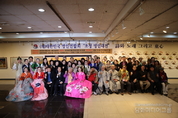
NGOs [LIVE] Where Tradition and Modernity Meet: The 2026 Korea Masters Invitational Exhibition Opens in Insadong
UNJournal Jon Lee | On February 25 at 2:30 p.m., the 2026 Korea Masters Invitational Exhibition officially kicked off in Insadong with an awards ceremony and Hanbok fashion show. "A place where tradition and modernity, recorded history and personal memories meet," is how Chairman of the Organizing Committee Lee Jon-young described the exhibition. Lee is also publisher of Diplomacy Journal.
- Jon Lee 기자
- 2026-03-07 12:22
-
UN members Diplomatic Journal 3 March 2026 Vol.203, TURKMENISTAN AND THE REPUBLIC OF KOREA EXPAND COOPERATION
UNJournal Jon Lee | TURKMENISTAN BILEN KOREYA RESPUBLIKASYNYN ARASYNDAKY HYZMATDA LYK OSDURILYAR 대만민국과 투르크메니스탄 간의 협력은 발전아고 있다 TURKMENISTAN AND THE REPUBLIC OF KOREA EXPAND COOPERATION
- Jon Lee 기자
- 2026-03-05 17:33
-
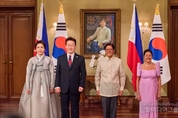
UN members Presidents Lee and Marcos Mark 77 Years of Korea-Philippines Friendship at State Banquet
UN Journal Kayla Lee | President Lee Jae Myung and First Lady Kim Hye Kyung attended a state banquet hosted by Philippine President Ferdinand Romualdez Marcos Jr. at Malacañang Palace in Manila on the evening of March 3, as part of President Lee's ongoing state visit to the Philippines. In his dinner remarks, President Marcos noted that the two leaders had agreed to fully realize the potential of the Korea-Philippines Free Trade Agreement for the benefit of both peoples. He also highlighted areas of cooperation including investment in the Philippines' military modernization, coast guard capaci
- Kayla Lee 기자
- 2026-03-04 14:38
-
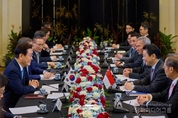
UN members President Lee and PM Wong Chart New Course for Korea-Singapore Strategic Partnership
UN Journal Kayla Lee | Korean President Lee Jae Myung held a summit on the morning of March 2 with Prime Minister Lawrence Wong during his state visit to Singapore. The two engaged in wide-ranging discussions on ways to deepen the strategic bilateral partnership, as well as major international issues, including the situation on the Korean Peninsula and developments in the Middle East. Prime Minister Wong welcomed President Lee, noting his pleasure at receiving him in Singapore just over four months after their previous summit in Seoul last November. He described the visit as "an important cata
- Kayla Lee 기자
- 2026-03-04 10:46
-
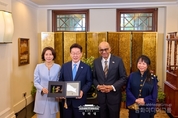
UN members Singapore President Highlights Shared Values with Korea at State Dinner
UN Journal Kayla Lee | On March 2, Singaporean President Tharman Shanmugaratnam hosted a state dinner in honor of President Lee Jae Myung’s official visit to Singapore. President Tharman expressed warm camaraderie, noting the many similarities between Korea and Singapore such as men in both countries fulfill mandatory military service. He added that he was delighted BTS would be performing in Singapore in December after completing their service obligations. President Tharman also noted that the people of the two nations are growing closer in everyday areas such as arts, culture, and sports, em
- Kayla Lee 기자
- 2026-03-04 10:42
-
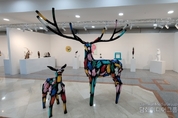
NGOs 2026 Seoul International Sculpture Festa Moves to Exhibition in National Assembly Complex
UN Journal Kayla Lee | From March 3 to March 6, the sculpture exhibition “Art is Industry – K-Art Where the People and the National Assembly Meet” will be held on the 2nd floor of the National Assembly Members' Office Building. Organized by the Korea Sculptors Association (KSA), this exhibition is the first official initiative to extend the achievements and discourse of the 2026 Seoul International Sculpture Festa to the National Assembly. Notably, National Assembly Speaker Woo Won-shik will personally attend, delivering a congratulatory address to honor the occasion and convey messages of enc
- Kayla Lee 기자
- 2026-03-03 16:02
-
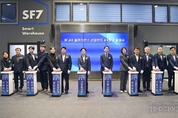
NGOs MOTIR Launches Industrial Complex AX Subcommittee for AI-driven Transformation
UNJournal Kayla Lee | A region-led framework to scale AI transformation (AX) across industrial complexes is now underway. On February 26, 2026, the Ministry of Trade, Industry and Resources (MOTIR) held the launch ceremony for the Industrial Complex AX Subcommittee, the 11th subcommittee under the M.AX Alliance, at the Changwon National Industrial Complex. Manufacturers, AI companies, universities, research institutes, and local governments attended the event and discussed the direction of the industrial complex AX and the subcommittee’s operating plan. The new subcommittee brings together mor
- Kayla Lee 기자
- 2026-03-03 14:22
-
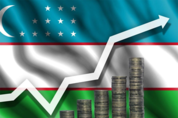
UN members Business Climate Analysis of Uzbekistan – CERR Survey
UNJournal Kayla Lee | In January, growth in the business climate was mainly driven by an outpacing increase in the expectations component. The agricultural sector and services became the key drivers of business confidence. The Center for Economic Research and Reforms (CERR) presented the results of its business climate analysis based on monthly surveys of entrepreneurs across the republic. Based on the collected data, a composite Business Climate Indicator was formed, reflecting both current assessments of business conditions and expectations for the next 3 months. Dynamics of Uzbekistan’s Com
- Kayla Lee 기자
- 2026-03-03 13:26
-
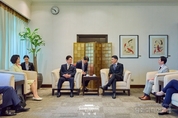
UN members AI Partners and Cultural Allies: Korea and Singapore Deepen Ties
UNJournal Jon Lee | Cheong Wa Dae Spokesperson Kang Yu-jeong released the following statement on March 2 about President Lee Jae-Myeong's meetings in Singapore: At tonight's state dinner, Singapore President Tharman Shanmugaratnam expressed warm feelings of kinship, noting the many things Korea and Singapore have in common. He began by pointing out that men in both countries are required to fulfill mandatory military service, adding that he was delighted BTS had completed their service and would be performing in Singapore in December. He also noted that the people of both nations are growing c
- Jon Lee 기자
- 2026-03-03 11:12
-
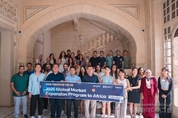
NGOs KAF Program Helps Startups Enter Africa
UNJournal Kayla Lee | The Korea-Africa Foundation (KAF) is recruiting startups to participate in the “2026 Global Market Entry Program” (GMEP), a project it hosts, the Ministry of SMEs and Startups oversees, and the Korea Startup Agency (KISED) manages. KAF has led the GMEP for the past three years, operating it as a locally focused accelerator program. Interested companies may apply between February 27 and March 31. In all, 15 tech companies will be selected to expand into Africa: seven from the climate field and eight from the health field, i.e., aging. For details, refer to the 2026 GMEP an
- Kayla Lee 기자
- 2026-03-03 09:45
-
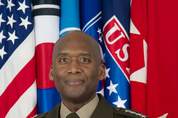
UN members February 18-19 USFK Drills over Korea's West Sea Lead to Conflicting Accounts
UNJournal Jon Lee | Multiple Korean news outlets are covering contradictory statements released by the offices of U.S. Forces Korea (USFK) Commander General Xavier Brunson and the Republic of Korea's Ministry of National Defense (MND). According to a February 25 Korea Times article, the controversy arose "from a large-scale U.S. Forces Korea (USFK) drill conducted Feb. 18 and 19 from Osan Air Base, during which U.S. fighter jets carried out more than 100 sorties over waters west of the Korean Peninsula. Chinese warplanes also scrambled in response, leading to a short aerial standoff between th
- Jon Lee 기자
- 2026-02-28 10:19
-
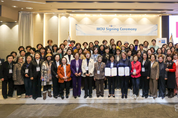
NGOs KGCCI and KNCW Sign MOU to Advance Women's Leadership in Korea
UNJournal Kayla Lee | The Korean-German Chamber of Commerce and Industry (KGCCI), the second-largest foreign chamber of commerce in Korea, announced on February 26 that its Women in Korea (WIR) program and the Korean National Council of Women (KNCW) signed a Memorandum of Understanding (MOU) to strengthen cooperation in advancing women’s leadership and fostering inclusive professional networks. The agreement formalizes collaboration in areas that include women's leadership mentoring, joint initiatives, information exchange, and participation in flagship programs such as WIR and the 2026 Joint
- Kayla Lee 기자
- 2026-02-28 10:17
-
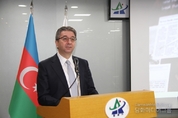
UN members Shared Pain, Shared Promise: Azerbaijan and Korea Reflect on Khojaly at Third Annual Symposium
UNJournal Kayla Lee | On February 26, the Embassy of the Republic of Azerbaijan to the Republic of Korea (ERA) and the DGIEA Korea–Azerbaijan Association held the Third Symposium dedicated to the 34th anniversary of the Khojaly Genocide. "On the night of 25–26 February 1992, Armenia's armed forces attacked the town of Khojaly and perpetrated mass atrocities against the Azerbaijani civilian population," the Embassy explained in a post-symposium statement. "During the bloodshed, 613 people — including 63 children, 106 women, and 70 elderly persons — were killed with particular cruelty" — with an
- Kayla Lee 기자
- 2026-02-28 10:14
-
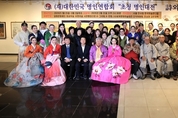
ArtsㅡCulture Where Tradition and Modernity Meet: The 2026 Korea Masters Invitational Exhibition Opens in Insadong
UNJournal Kayla Lee | On February 25 at 2:30 p.m., the 2026 Korea Masters Invitational Exhibition officially kicked off in Insadong with an awards ceremony and Hanbok fashion show. "A place where tradition and modernity, recorded history and personal memories meet," is how Chairman of the Organizing Committee Lee Jon-young described the exhibition. Lee is also publisher of Diplomacy Journal. This description is particularly fitting for the works of calligrapher and painter Yoo Hyeon Byeong. Three distinct series by Yoo are presented in this exhibition. His ho (號)—artistic sobriquet—"Bamgugyeon
- Kayla Lee 기자
- 2026-02-28 10:03
-
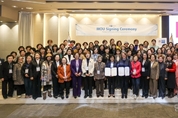
NGOs KGCCI and KNCW Sign MOU to Advance Women's Leadership in Korea
UNJournal Kayla Lee | The Korean-German Chamber of Commerce and Industry (KGCCI), the second-largest foreign chamber of commerce in Korea, announced on February 26 that its Women in Korea (WIR) program and the Korean National Council of Women (KNCW) signed a Memorandum of Understanding (MOU) to strengthen cooperation in advancing women’s leadership and fostering inclusive professional networks. The agreement formalizes collaboration in areas that include women's leadership mentoring, joint initiatives, information exchange, and participation in flagship programs such as WIR and the 2026 Joint
- Kayla Lee 기자
- 2026-02-27 10:12


-
2026-03-07 12:22
[LIVE] Where Tradition and Modernity Meet: The 2026 Korea Masters Invitational Exhibition Opens in Insadong
-
2026-03-05 17:33
Diplomatic Journal 3 March 2026 Vol.203, TURKMENISTAN AND THE REPUBLIC OF KOREA EXPAND COOPERATION
-
2026-03-04 14:38
Presidents Lee and Marcos Mark 77 Years of Korea-Philippines Friendship at State Banquet
-
2026-03-04 10:46
President Lee and PM Wong Chart New Course for Korea-Singapore Strategic Partnership
-
2026-03-04 10:42
Singapore President Highlights Shared Values with Korea at State Dinner

Address: Doosan We've Pavilion 1203, Sambong-ro 81, Jongno-gu, Seoul
Date of first registration: Founded in 1996 as UN News, discontinued in 2009
Registration No.: Jongno Ra00610
Registration Date: Reissued on Sept. 18, 2023
Publisher: Damwha Media Group Chairman Lee Jon-young
Editor in Chief: Lee Jon-young/ Vice Chairman: Chung Bo-won/Standing Advisor Lee Keon-chan | Senior Editorial Writer Ko Jae-hwe/ Cultural Editor Lee Joon-seok/ Political Editor: Kayla Lee
Phone number: 02-3417-1010 | 02-396-5757
E-Mail: djournal3417@gmail.com

UPDATE: 2026년 03월 07일 12시 23분